EIGRP: Scaling and Accelerated Convergence - CCNP ENSARI
EIGRP Scaling + Converging
EIGRP Convergence
Path recomputation must occur for any prefix when an EIGRP neighbor moves to a down state, where an EIGRP upstream router was a successor. If a feasible successor is not available for the prefix, new route calculations are perform using DUAL and the route state changes from passive to active.
Query packets are sent out when a router detects a topology change directed toward EIGRP neighbors for that route, the delay is set to infinity so that other routers are aware of its state. This process continues until a router establishes the query boundary where a router does not mark the prefix as active -- meaning a queries have been satisfied.
EIGRP queries can sometimes be delayed due to packet loss , slow neighbors or large hop counts however DUAL is very efficient in finding loop-free and backup paths very quickly. If a neighboring router fails to respond within 90 seconds of a query the router is consider SIA, or Stuck In Active, in which the originating router sends a SIA query to all EIGRP neighbors that did not reply. If an SIA is declared DUAL removes all routes from that neighbor.
*NOTE: Troubleshooting can only occur on active EIGRP prefixes when a router is waiting on a reply.
EIGRP Route Summarization
As EIGRP autonomous systems grow larger, scalability of an EIGRP autonomous system depends solely on route summarization. Such optimizations involve shrinking routing tables, creating query boundaries that decreases query domains during convergence. If summarizing routes in an hierarchical fashion, scaling requires deployment of an IP addressing scheme.
EIGRP network prefixes are summarized on an interface-by-interface basis which means a summary aggregate is configured on a specific EIGRP interface. Prefixes within the summary aggregate are suppressed and only the summary prefix is advertised. Using [leak-map] options allows routes to be advertised that were included in a route map. Summary routes are always advertised on outgoing interfaces, therefore [af-interface default] option cannot be used because it requires a specific interface.
Manual summarization stabilizes convergence by not operating DUAL at every instance a route within the summary is detected. This eliminates the burden of re-calculating smaller prefixes and can be accomplished statically setting the metric on a summary aggregate with the command: summary-metric network {prefix-length | subnet mask} bandwidth delay reliability load MTU.
EIGRP WAN Considerations
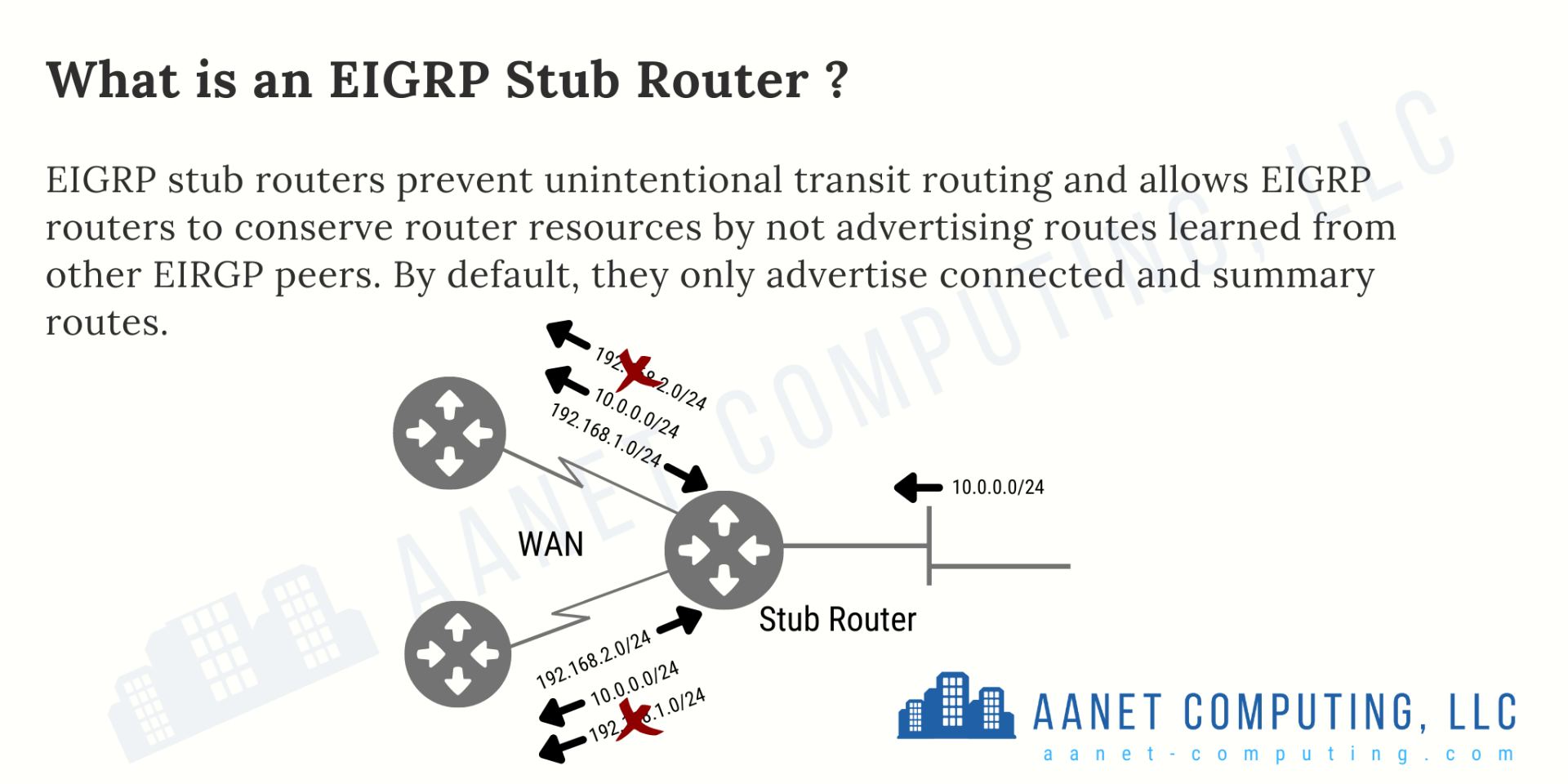
EIGRP stubs by default only advertise connected and summary routes, it announces itself as a stub within EIGRP hello packets so that neighboring routes can update their neighbor table to reflect that status. EIGRP does not send queries to an EIGRP stub router allowing for faster convergence. In short EIGRP stub feature prevents he EIGRP stub router from becoming a transit site, but can allow downstream routers to receive and advertise networks across the WAN. This works by identifying the WAN interfaces with a EIGRP stub site identifier.
Split Horizon
Advertising a route back to the originating is called a reverse route. In order to prevent routers from re-advertising routes out of the same interface it was learned from you must configure split horizon on that interface. By default EIGRP enables split horizon on all interfaces, however should be disable when an interface connects to multi-access router that does not support full-mesh.
Route Manipulation
Selectively identifying routes that are advertised or received from neighboring routers is known as route manipulation.
Route filtering from an interface is supported by EIGP and are matched against ACLs, IP prefix lists, route maps. Gateway IP addresses. Inbound filtering drops routes prior to DUAL processing which prevents routes from being install in the RIB, filtering performed outbound are process by DUAL and installed locally in the RIB of an advertising router. Specifying an interface restricts the filtering to the interface the route was received on. This is accomplished by:
distribute-list {acl-number | acl-name} | prefix prefix-list-name | route-map route-map-name | gateway prefix-list-name {in|out} interfaced-id
Lacoste, Raymond; Edgeworth, Brad (2020.) (CCNP Enterprise Advanced Routing ENSARI, Official Cert Guide.)